SAILOR GEORGE
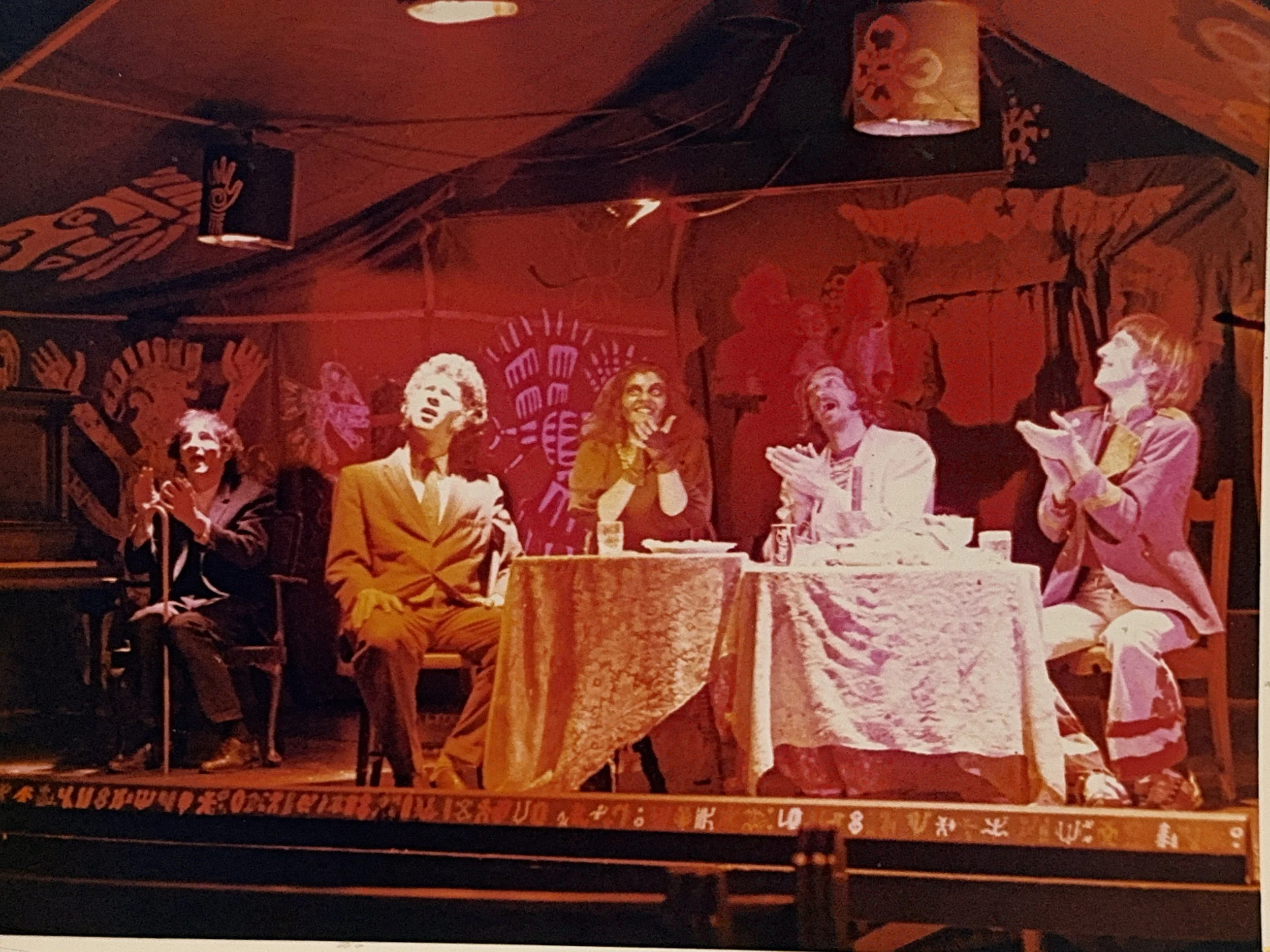
Written and directed by Jim Stowell
Produced by The Minneapolis Ensemble Theater
1972
“‘Sailor George’ which was given its premiere last night by The Minnesota Ensemble Theater, is a funny, fantastic, suggestive and cryptic play. The new play is a total theatrical experience which some might label unconventional or experimental but which struck me yesterday as richly realized and based on carefully considered, coherent principals.”
“‘Sailor George’ is a pretty strange play, and I’m not at all sure what all of it means but there are many uproarious scenes, especially a zany one in a restaurant involving the young man, a philosopher and a mad waiter. If you are responsive to avant-garde theater I suspect you’ll find it joyous and fresh and intriguing. I hope I can find a chance to see it again.”
“I finally caught up with the Minnesota Ensemble Theater’s production of ‘Sailor George’ by James Stowell and I was seriously bothered by only one thing, a Felliniesque surrealism in all of this but it’s the rich comedy that holds it all together. It’s an inspired, sensual, totally absorbing theatrical experience.”
“My first observation on entering the theater was how beautifully this company surrounds the audience in the environment of the play. In this case, the seats are surrounded by canvas tenting extending all the way to the stage where the playing area is also enclosed by a large tent. Immediately we’re all in this together.”
1972. Canvas has been hung in the Ensemble’s playhouse, to create the atmosphere of a cave or tunnel; and the audience can feel like it sharing the same enclosure with the actors and not looking at the play across a barrier.”
This is my second play. I remember very little about the actual play but I have great memories of the play. This was a very important play for me as a young writer. It was a smash hit. People raved about this play. Audiences loved it. People from other theaters came to see the show. This play put me on the map. Reviews said my plays are a kind of Alice in Wonderland but I was more Carlos Castaneda in those days.
The Tattooist/Sailor George…Peter Ostroushko
The Traveler…William Ratner
The Witch…Ruthann Zazeela Cohn
The Witches Husband…Doug Grina
The Waiter…David George
The Philosopher…Jim Campbell
The Hero…Todd Knaeble
All The Other Women…Susan Pochapsky
Man in the Dark Coat…Peter Scangarello
In the program the Director is listed as Lamont Cream. This is me. I was probably on a thing about having my name in the program too many times.
Set design by Jim Stowell. (Apparently, this was okay.)
Lights by Lief Grina. Lief is Doug’s younger brother. Lief comes back to help me and The Palace Theater in the Guthrie-2/Southern Theater situation years later.
Pictures by Colin Rich.
Joe and I were at what, in those days, was called an Army-Navy Store. A warehouse of everything you can think of from all branches of the military. Joe was looking for something for a play we were rehearsing and I was acting in. I saw a huge canvas lump and asked the guy who worked there what that was and he told me it a mess tent. You know, a tent where soldiers eat. It held a couple of hundred people. It weighted, in my memory, 250 pounds. It cost $50.00 I was working on Sailor George. Very, very early stages. The way I like to put it is, I was starting to pack my bag for my trip to Mars. Anyway, as soon as I saw that tent I wanted it. I didn’t know exactly what I was going to do with it but I knew I could use it somehow. Luckily, I had nothing to do with moving the tent or setting it up. Colin Rich and Todd and probably Grina led that group. They figured out how to enclose our theater and the entire stage area with the Army tent. The smell when you came into that room/tent was so evocative. The smell would remind you of every camping trip or any time you have ever been in a tent. The smell was a real plus for creating an atmosphere inside the tent. Helping the inside of the tent to be a whole separate reality, as Carlos Castaneda would say. Then, I told Colin I wanted pictures on the walls of the tent onstage. But not regular tattoo stuff. Mythical figures. When you look at the group photo you can see a little of Colin’s work. I can’t remember all the different mycological figures he found and painted. One I remember was Mayan and one Sufi but there were many. I think it was my idea to cut the onstage tent along the seams. The tent canvas was so heavy that when the tent was cut along the seams between sections when an actors entered pushing or slipping between the sections of the tent the tent would return to its original shape. It looked like the character has just come through the wall of the tent. The actors/characters could pass in and out of the walls, like magic. It truly was an extraordinary effect. Magical.
The lights. The lights were a part of the set. We only had 7-8 lights. We did have two strips of footlights. They were painted black, of course. Colin painted many different small figures in many different colors on those footlights. Because of the angle the audience looked at the stage for people sitting in the front rows the foot lights seemed to make the actor’s feet disappear. Several people who saw the play said it was like the people on stage were floating or flying and it helped with the magic-realism of the play.