fresh meat
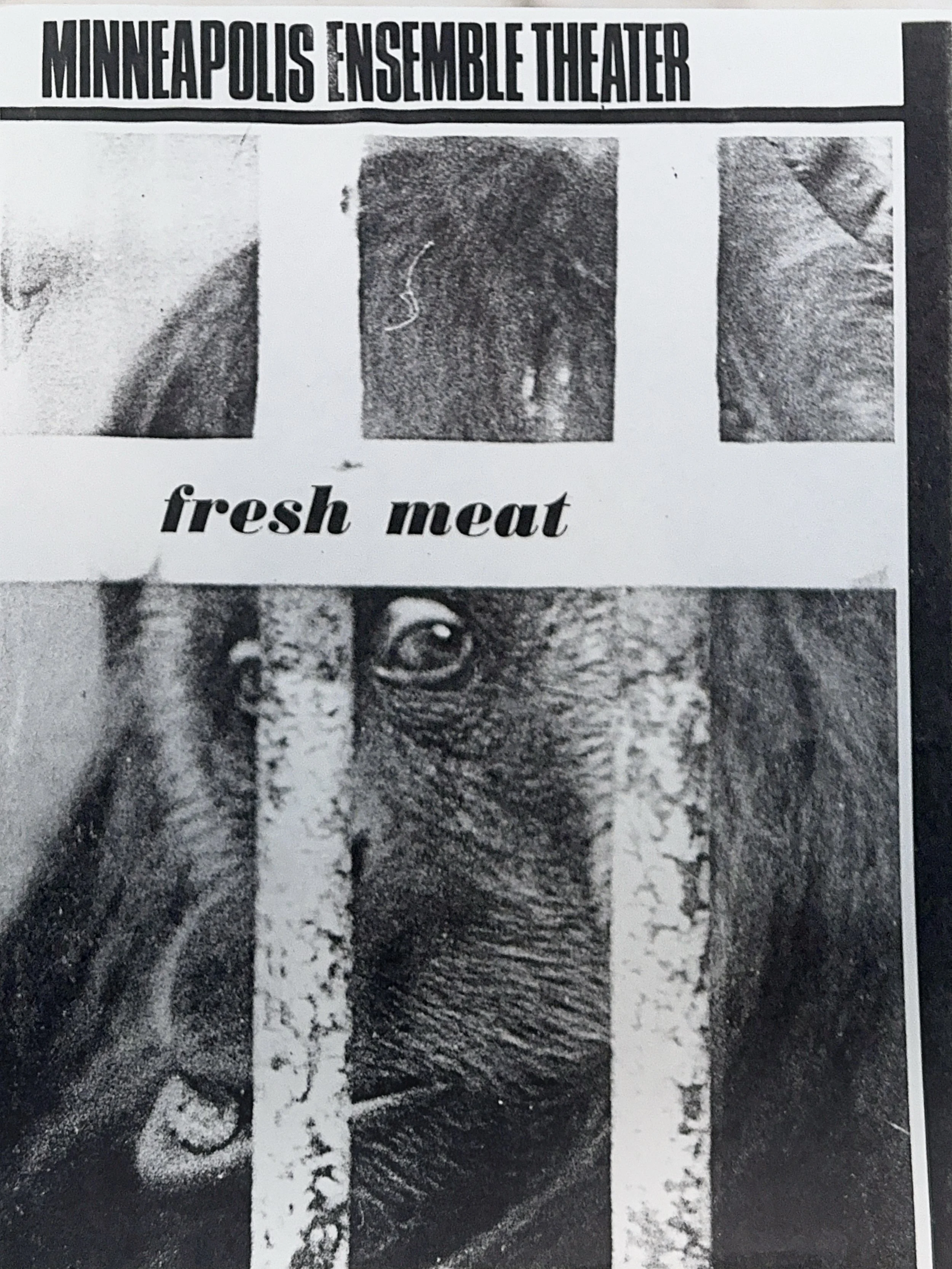
Written and directed by Jim Stowell
Produced by The Minnesota Ensemble Theater
1971
“Fresh Meat is no diet for all, but is heaty fare for the thinker. It is the most exciting radical theater production I’ve seen in the Twin Cities. Embracing its audience, integrating music and motion and language and ritual and combining visceral force with outrageous satire, ‘Fresh Meat’ is a freewheeling, high-spirited, sometimes funny and sometimes stunning event.”
This is my first play. I have wanted to be a writer since I was a boy. I wanted to write the great American novel. When I started acting, I was so in love with acting I forgot about writing. After being the lead actor at the Minnesota Ensemble Theater for about two years the other members of the company told me they wanted me to direct them. I was flattered and very excited. I spent the summer writing the play. The actors didn’t ask me to write a play for them but to direct them in a play. I was the one who decided to write a play. The title was Fresh Meat. The idea was, people being treated like meat. I don’t remember the first script. I mean, I remember nothing about it. We started changing the play immediately after the first reading and we ended up with a completely rewritten play. The only things that remained from the original was the title, Fresh Meat, and the idea of people reduced to objects/meat.
At the MET we were influenced by Jerzy Grotowski and his book, Towards a Poor Theater. We were certainly poor. I took to Grotowski’s physical method. This play was also influenced by the fact that I grew up in the Rio Grande Valley of Texas and my little hometown had a prison camp for, “illegal emigrants.” Spotlights, barbed wire fences, towers with men holding automatic weapons. I grew up seeing brown skinned people treated as objects/meat. Also, a book called, Try to Look, Try to See. A book of poetry about a Nazi death camp written by a little girl in the camp. The third major influence was research into the people who worked at the stockyards in Saint Paul and meat packing plants in Minneapolis. As a result of this play, I became a vegetarian. Not because I was shocked and appalled by what I learned or saw. I was taken to a slaughterhouse in Mexico when I was a little boy and watched the entire process of killing, skinning and butchering a cow. I was around farms and ranches growing up and went hunting with the adults so I had seen the insides of several different kind’s animals. No, I was personally angry and insulted by how I was treated when I was going around to places in Minneapolis and Saint Paul asking questions. I had no intent of writing the next, ‘The Jungle.’ Or some kind of expose. As I said, I was not appalled by the process but I never got past the front door to see how they are doing it today. No pictures and no talking about what they do or how they do it and we don’t give a damn if you like that or not. One guy said, “Fuck off!” The people in the offices were so rude and treated me so badly that one day I said to myself, “These assholes are never getting another penny of my money.”
Looking at my notes about the play I have found what I think is most of the play. That is, most of the written part. Most of this play and especially this kind of play is not down on the page. Only a little of the blocking is written and only basic lighting information. The improvisational movement and the lighting that are not in the script are a big part of telling the story of this play.
The play is in three parts. The opening where the audience is brought into a room one at a time. Now they are separated from the others and lead into a room where they don’t know what is going to happen. Then, they are weighed and have their name and their weight called out. So, for a few moments each audience member becomes, meat. Part two is the body of the play. An archipelago of stories/scenes in the main stream idea of the play. Part three is the final two scenes. This is where the audience has been headed from the opening. The breaking bread. Instead of having a scene in the play illuminating the emotions of people singing and breaking bread together this kind of theater brings the audience onto the stage. No more classical separation of audience and actors. I brought the audience onstage to cross that line. Then, actually having the audience personally experience the emotions. It is very much like what I grew up with and is called, ‘The Cowboy Way.’ Don’t talk about it just do it. Don’t talk to them about the emotions, have the audience personally experience the emotions.
The Cast—Mim Solberg, Mike Green, Todd Kanable, Peter Ostroushko, David George, Bill Ratner, Ruth Ann, Keith Walter. Was Jim Campbell in this show? Was there an actress in the play named Sue Bachler? The program shows nine names. But, in those days I was on some trip about there being no “stars” or “lead” actors. We were an ensemble so no one could use their real name. In the program where an actor’s real name would be they made up names for themselves and they made up names for their characters as well. This is what I remember…
Mim Solberg was Little Lulu as The Triple Threat.
Mike Green was Uncle Woozer as The Real Father.
Bill Ratner was Ratfatback as Dem Bones O. Picayne.
Ruth Ann was Red Lips as Neon Wilderness.
Keith was Hai Flyer as A Crapping Rapscallion.
I can’t remember who David George was. Either Frodo Figueroa II as Darby Kid of the Wowo or Garcia Lafern as Destiny.
David Morris, who was not in the play but was a part of the theater through Joe W and we all liked him. He took the tickets for this show I think in the program he is Uncle Wendel as Himself. But I am not sure. There are nine names in the program and I can only be sure of seven actor’s matching names and one maybe.
As I go through the pieces of the script, I am slowly relearning the play. Catching its rhythm. I’m starting to see what I was getting at. What I was thinking then. What I was trying to do and say and very importantly, how I was trying to say it. At first glance I kind of thought it was a very raw, immature work. I’m starting to see something. Going through the script made me remember thinking that because we are an ensemble I must give the actor’s moments to shine. Mike, Ruth Ann, Bill and Peter all had speeches written for them or we wrote them together. For example, I started by writing the Hanging Meat scene but Bill Ratner took it over and polished and finished it.
I will describe opening scene of the play because it illustrates the kind of theater I was doing at this point in my life as an artist.
The audience are standing in very small waiting room for the doors to open and they can enter the theater. They are brought into the theater one at a time. An actor opens the swinging doors to the theater and picks out an audience member. This actor is wearing sweat cloths and a long bloody butcher’s apron. There was never trouble with couples. Our audiences were not that big and the theater was an old church with more than enough room for one half of a couple to be brought in first and be seated and then the other half is brought in 4-5 people later they could see each other and be able sit together with no problem.
All the actors wore sweat cloths. Some people thought this was a costume choice made to match the play. And it did. Looking back everyone in sweat cloths with bloody aprons was great costuming. But, it was not a choice. It was a screw-up. A good-looking lady about my age was supposed to be creating our costumes. She showed me drawings. We talked about my idea of what I wanted. After a week I contacted her. We met and talked and she made excuses about being behind but I was not to worry. Several more meetings and two days before we opened, she confessed there were no costumes. Thus, their sweat cloths as costumes. I never pressed her and never demanded to see the damn costumes. When she made excuses, I didn’t fire her and move on. Instead, I just kept accepting her excuses. I didn’t do that anywhere else in the production. I was a hard case. It wasn’t because I was trying to screw her so I didn’t care about the costumes as long as I got laid. I was in a committed relationship. It was because of my lack of experience. This was my first play. I had never been in charge of everything. I often felt overwhelmed, especially by the writing part, so when she said not to worry about the costumes, I was only too happy to do just that so I could get back to thinking about what really mattered to me. The play. This was the first example of a problem of mine which was to come back again during my life in theater. Sometimes I trust the wrong people.
An actor chooses an audience member and brings them into the theater. Just inside the door is a large stand-up scale. Two actors are standing there wearing long bloody aprons. Depending, an actress or an actor escorts the person the scale and they are weighed. They are asked their first name. Once they are weighed the actors call out, in a loud voice, the weight and the person’s name. Then the audience member can find a seat. On stage different kinds of vaudeville acts are going on. Mim and Todd do a dance. Very Paris. Both wearing berets and stripped T-Shirts. Tango music. Peter, Bill and David play a nose-flute trio. I can’t remember the other acts but the acts keep going during the time the audience is being brought in. For the audience the atmosphere might seem a little chaotic or maybe it seems a little bit crazy. That’s the idea. The audience feels like they are being swept away into another world.